Choosing Your Tools: Rotary Cutters for Quilting
Rotary Cutters
Choose the best quality tools you can afford. Quality doesn’t have to mean expensive—just effective and reliable. Always try out tools before you buy them if possible. Rotary cutters come in many styles and sizes, so it’s important to find one that feels good in your hand and suits your quilting needs. Here are some guidelines to help you decide.
Safety First
Rotary cutter blades are razor sharp. Always:
- Don’t buy discount blades. The money you save is not worth the aggravation.
- Rotary cutter blades are exceedingly sharp. They can cut quickly and viciously, so treat them with extreme care. Get in the habit of engaging the safety guard immediately after use.
- Change blades carefully, preferably on a flat surface with a container ready for disposal. If you find that the blade is not working properly after you have changed it, double check to make sure you only installed one. They do stick together.
- Keep out of reach of children and anyone unfamiliar with proper use, including overly curious cats, children, and spouses.
- Use with the proper tools: a self-healing cutting mat and a quilting ruler. Never substitute a regular ruler—it’s not thick enough and could lead to slips or injury. If you lose control of your rotary cutter, you may end up with a poor cut, a damaged blade, or, worst of all, a bad gash on your hand.
Pro tip: Always cut standing up, with the cutter moving away from your body for maximum control.
Understanding Rotary Cutter Sizes
Rotary cutters are categorized by blade size.
- 18mm blade – Perfect for intricate cutting like paper piecing or trimming appliqué motifs.
- 28mm blade – Ideal for curves and small template cutting.
- 45mm blade – The most commonly used size for general quilting and fabric cutting.
- 60mm blade – Best for cutting multiple layers and thicker fabrics.
- 65mm blade – (Fiskars only) A slightly larger option for maximum coverage and efficiency.
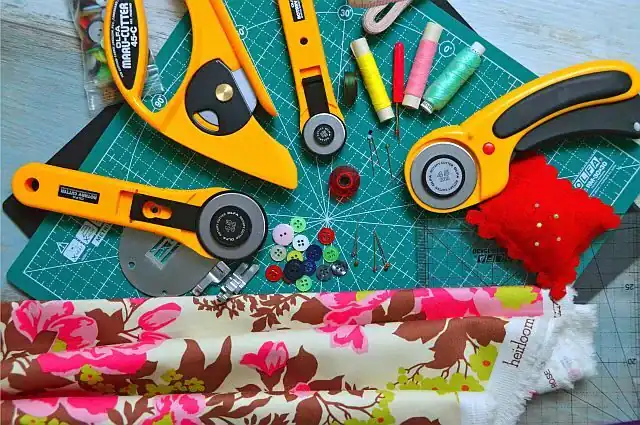
Rotary Cutters (not all brands are shown below)
Clover yellow and green rotary cutter has a gently curved soft handle which can be used both right and left-handed.

Fiskars gray and orange rotary cutters are available in two styles, both with a large round grip.
Martelli red rotary cutters have a curved shape. This rotary cutter is excellent for quilters with carpal tunnel, as it places pressure on a different part of your arm. Martelli cutters come in both right and left versions and use blades specific to the brand.

Olfa makes three types of gold colored rotary cutters, one with a hard plastic handle and one with a handle that you have to squeeze and hold to use. The third kind has a split guard so you can use it in the right or left hand.
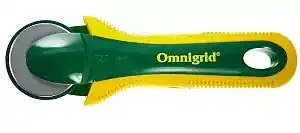
Omnigrid yellow and black rotary cutters have a gently curved plastic handle with a blade which engages automatically when pressure is applied.
What is the best rotary cutter for quilting?
There’s no one-size-fits-all cutter. The right one depends on your hand size, quilting style, and how much cutting you do. Try different types and find what works best for you—comfort, safety, and ease of use are key.
related quilt tutorials
-
How to Make a 3-color QST using the Tucker Trimmer
There is a free chart at the end of this tutorial for newsletter subscribers. If you would prefer not to subscribe, use the Print Friendly button under that list to print this page. If that doesn’t work, try Ctrl-P or Flower-P. The 3-color Quarter Square Triangle block (also known as a 3-part or split QST)…
-
The Dirty Truth About Clean Fabric
You’ve heard it a million times: wash your fabric before making a quilt. It stops fabric from shrinking and bleeding, and catches any bad behavior early—like raveling, going off-grain, or running away with the mailman. But do you really need to do it? For this article, let’s define prewashing as treating your fabric the same…
-
How to Fussy Cut a Block
I found this marvelous Halloween fabric, but couldn’t decide how to use it! I finally decided to pick out some cute motifs and put them in the center of a block. Here is the fabric I had. The motifs seemed to lend themselves to a 4-1/2″ block, so I got out my Cute Cut Fussy…